How to play backgammon
Two players race their 15 checkers around the board and off it. You move by rolling two dice. The first player to take all 15 checkers off wins. Along the way you can hit your opponent's lone checkers and send them back to the start.
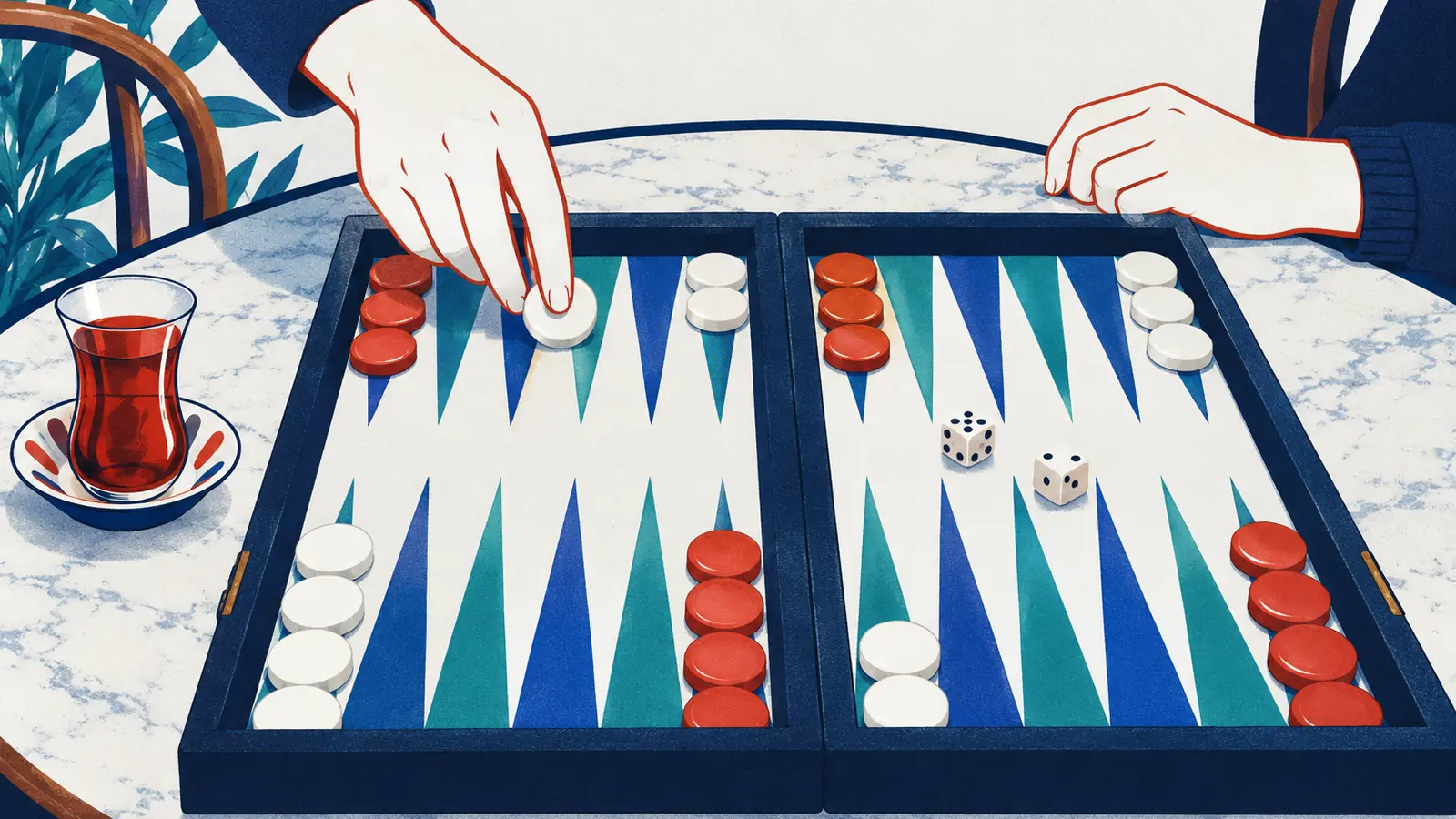
1. The goal and the setup
Each player starts with 2 checkers on their 24-point, 5 on the 13-point, 3 on the 8-point and 5 on the 6-point. You move from your 24-point towards your 1-point; your opponent moves the other way round. See the full setup guide for diagrams.
2. Who starts
Each player rolls one die. The higher number goes first and plays both of those numbers as their first move. If the dice are equal, roll again. So in backgammon the very first move is never a double. After that, players take turns rolling both dice.
3. Moving the checkers
- Each die is a separate move. With a 5 and a 2 you can move one checker 5 and another 2, or one checker 7 (it stops on the point in between, which must be open).
- A checker can land on any point that is empty, has your own checkers, or has just one opposing checker. A point with two or more opposing checkers is closed.
- Doubles are played four times. A roll of 4-4 gives you four moves of 4.
- You must use both dice if you can. If only one die can be played, play it; if either could be played but not both, you must play the larger one. If nothing can be played, your turn is over.
4. Hitting and entering from the bar
A single checker alone on a point is called a blot. If your checker lands on your opponent's blot, it is hit and goes to the bar in the middle of the board.
A player with a checker on the bar must bring it back in before moving anything else. It enters in the opponent's home board: a 1 enters on your 24-point, a 6 on your 19-point. You can only enter on an open point.
If none of your numbers can enter, you lose the whole turn. When all six points of a home board are closed, the player on the bar cannot move at all until a point opens.
5. Bearing off
Once all 15 of your checkers are in your home board, you can start taking them off. A die takes off a checker from the matching point: a 4 from the 4-point. If the matching point is empty, you must move a checker from a higher point. If there is no checker on a higher point, the die takes off your highest checker. You can also move inside your home board instead of bearing off.
If one of your checkers is hit during the bear-off, it must come back home before you take off any more. More on this in bearing off.
6. Winning and scoring
- Single game (1 point): the loser has taken off at least one checker.
- Gammon (2 points): the loser has taken off none.
- Backgammon (3 points): the loser has taken off none and still has a checker on the bar or in the winner's home board.
Games can be played one at a time or as a match to a set number of points (for example first to 5). With the optional doubling cube the stakes can double during a game. In a match, once a player is one point from winning, the next game is played without the cube (the Crawford rule). See the doubling cube and win types.
There are no draws in backgammon: someone always bears off first.
Turkish tavla: what changes
| Rule | Backgammon | Tavla (Turkish style) |
|---|---|---|
| First move | Higher roller plays the two opening dice | Higher roller rolls both dice again, so a double is possible |
| Later games | Opening roll every game | The winner of the last game starts |
| Gammon | 2 points | Mars: 2 points |
| Backgammon | 3 points | No triple win: still 2 |
| Doubling cube | Optional | Not used |
| Match | Often 1, 3, 5 or 7 points, Crawford rule | Usually first to 5 points, no Crawford rule |
Setup, movement, hitting and bearing off are the same. More in Tavla: Turkish rules.
Questions people ask
Do I have to use both dice?
Yes, whenever you legally can. If only one number can be played, play it; if either could be played but not both, play the larger.
Can I move a checker past a closed point?
Yes, as long as each point where it touches down is open. With a 6-1, a checker can jump over closed points if the point 6 away (or 1 away, then 6 more) is open.
What happens if I roll a double?
You play that number four times. 3-3 means four moves of 3, with one checker or several.
Can backgammon end in a draw?
No. The game ends the moment one player has borne off all 15 checkers.